


Diverse Supplies × TAS Blanket Insulation: A New Partnership Bringing Fast-Payback Energy Savings to Egypt
Industrial energy loss is rarely obvious. It hides in plain sight: exposed valves, bare flanges, noisy compressors, and fittings left uninsulated after maintenance. Yet these “small” gaps quietly drain budgets, compromise safety, and inflate carbon footprints.
In November 2025, Diverse Supplies announced a new partnership with TAS Blanket Insulation (Hungary, EU), a specialist in custom-made, removable-reusable insulation blankets and jackets designed to cut heat loss, improve safety, and support sustainability goals across industries.
This partnership directly supports Diverse Supplies’ mission: helping Egyptian manufacturers save energy, reduce operational losses, and move closer to decarbonization through proven technology and disciplined deployment.
What are removable insulation blankets and why do they matter?
Removable insulation blankets (also called insulation jackets) are multi-layer insulation systems manufactured to fit specific industrial components—such as valves, flanges, strainers, steam traps, PRV stations, headers, pump housings, heat exchangers, and boiler doors.
Unlike traditional rigid insulation that often gets damaged and discarded during maintenance, TAS blankets are designed to be removed and reinstalled in minutes, allowing plants to keep equipment accessible without sacrificing thermal performance.
Why this is especially relevant for Egyptian industry
In many facilities, high-maintenance fittings are left partially insulated—or not insulated at all—because teams need frequent access. The result is a costly cycle:
- Heat losses that increase fuel consumption
- Higher boiler load and more stressed utilities
- Elevated surface temperatures that raise burn risk
- Inconsistent insulation quality after maintenance
- Recurring insulation waste and rework
TAS’ removable-reusable approach is designed to break that cycle—without slowing maintenance.
What TAS brings: a complete insulation portfolio now available through Diverse Supplies
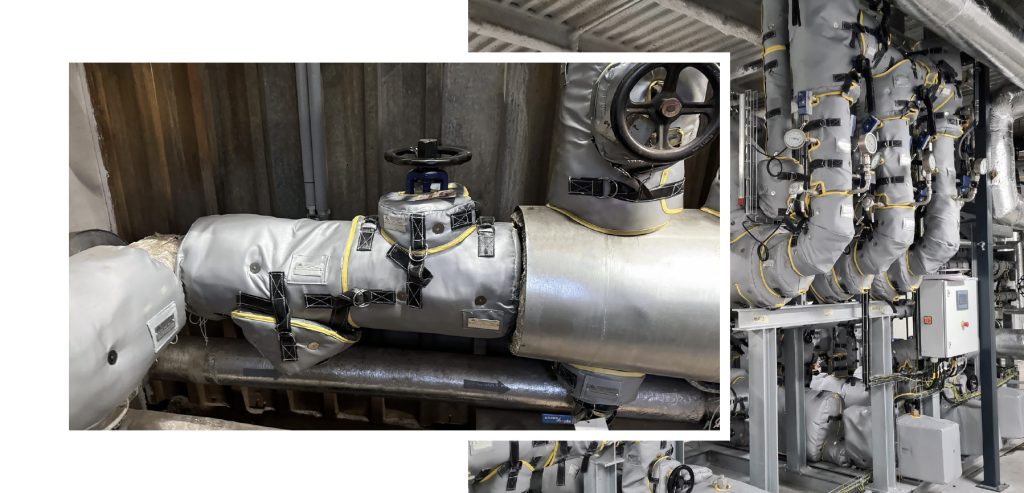
TAS Blanket Insulation provides solutions across thermal efficiency, safety, and noise control, with product families that fit multiple industries and duty conditions.
1) Thermal insulation blankets for steam, hot water, and process systems
This is the highest-impact starting point for most plants—especially those with steam networks and boiler rooms.
Typical targets include:
- Steam systems: valves, flanges, strainers, separators, steam traps, expansion joints, headers
- Boiler areas: boiler doors, manways/handholes, safety valves, level gauge connections
- Hot water & condensate systems: pumps, fittings, heat exchangers
- High-temperature process equipment: ovens/furnaces access points, vessels, domes/heads, irregular geometries
Why plants adopt it:
- Energy savings: heat loss drops dramatically once insulation is installed—often delivering 3–15 month payback.
- Easy maintenance: designed to be installed/removed quickly, without special training.
- Sustainability: poor or missing insulation drives “massive harmful emissions”—blankets help reduce CO₂ immediately and effectively.
- Workplace safety: covers hot surfaces, reduces noise, and protects against leaks/spray-outs—improving conditions for teams on the floor.
2) Food processing / sanitary insulation (washdown-ready)
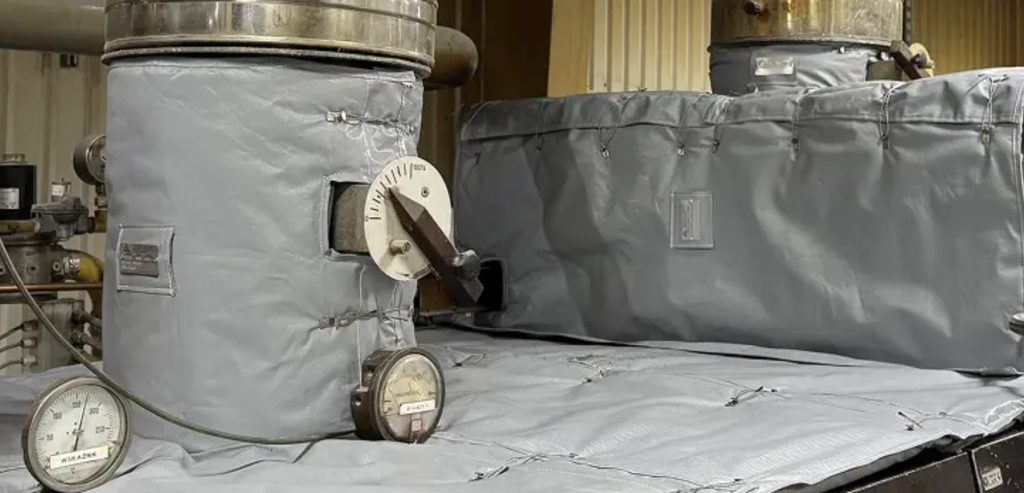
For food, beverage, and sanitary processing areas, TAS offers designs using washdown-appropriate, non-porous solutions, including PTFE jacketing fabrics and “easy-clean” surfaces to help reduce contamination risk while still delivering thermal performance (as presented in TAS’ materials and application approach).
This is particularly relevant for:
- pasteurizers, sterilizers, evaporators
- sanitary steam networks and utility connections
- areas requiring frequent cleaning and inspection cycles
3) Refinery / petrochemical and heavy process applications
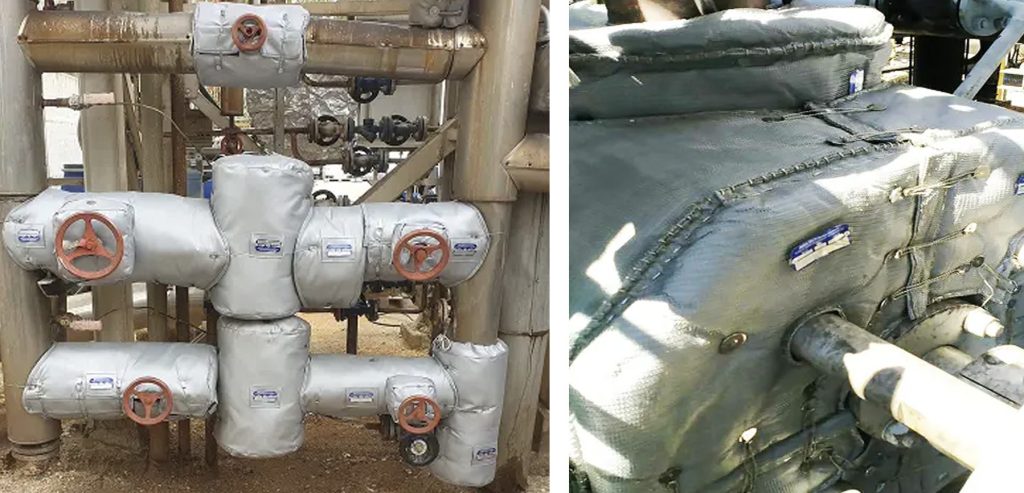
TAS designs include options for harsh environments with oil and weather resistance and high-temperature requirements—supporting complex surfaces that are often left uninsulated in refineries and chemical plants.
They also provide antistatic insulation options for hazardous-area applications where static control can be a requirement.
4) Acoustic insulation blankets for noise control at the source
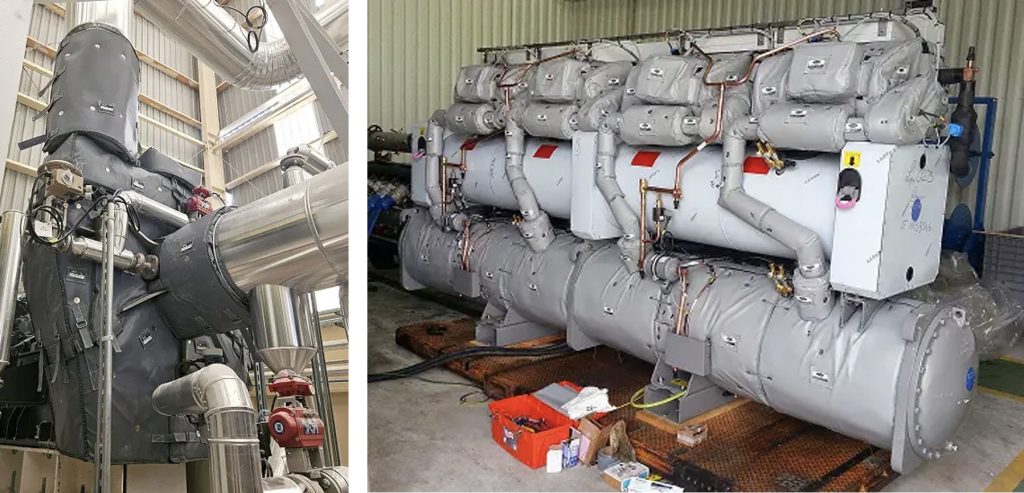
Industrial noise reduction is often easiest when addressed at the equipment surface—before sound spreads.
TAS’ acoustic insulation solutions are built to be custom-fit and removable, helping plants reduce employee exposure and improve workplace comfort, particularly around compressors, pumps, fans, and noisy piping runs.
- Proven noise reduction: 4–15 dBA (depending on design and conditions)
- For example, ~9 dBA reduction (measured at 1m) was achieved with a water-cooled chiller acoustic insulation applied directly to compressors and piping.
- Up to 15 dB(A) reduction was achieved with a standard acoustic kit applied to reciprocating compressors and fans.
5) Safety-focused protection: more than just “insulation”
Beyond thermal and acoustic benefits, TAS provides dedicated safety products designed to help protect people, equipment, and sensitive devices:
- Safety spray shields to help contain/redirect leaks or sprays from pressurized fittings
- Protective enclosures to shield actuators, sensors, and control components from weather, washdown, and contamination
- Passive fire protection blankets designed to protect motor-operated valves (MOVs) and other critical equipment for an extended period during fire exposure
These solutions are especially relevant where plants want to reduce risk from hot surfaces, leaks, washdown exposure, or harsh outdoor environments.
Industries served include:
Food processing, pharmaceuticals, chemicals, oil & gas, beverage, plastics extrusion, power generation, paper & pulp, marine, laundry services, HVAC (acoustic), OEM, and commercial properties.
What makes TAS blankets different: details that protect your ROI
In industrial insulation, quality is not cosmetic—it determines lifespan, maintenance speed, and heat-loss performance. Low-quality blankets can fail quickly due to exposed gaps, weak fastening, and construction shortcuts—creating recurring replacement costs and ongoing heat loss.
TAS emphasizes features built for long-term reusability and exact fit:
- Custom CAD-designed for precise fit and finish for each piece
- Double sewn and binded edges
- Metal embossed ID tag for easy identification
- Low-point “leak detector” grommet
- Weather / oil / chemical resistant specifications
- Expected lifetime: 15 years
The business case: numbers that make insulation a strategic decision
High quality removable insulation is a quick-payback, long-lasting upgrade—especially in steam systems and high-loss fittings.
Example project economics from a steam system case study by TAS
- Project cost: € 35,923
- Annual operating cost without insulation: € 84,282
- Annual operating cost with insulation: € 8,685
- Annual saving: € 75,597
- Payback period (ROI): 6 months
- Lifetime savings cited: € 1,098,211
TAS + Diverse Supplies: the difference is engineering + execution
TAS is an engineering-led manufacturer with EU-based design and production, and a track record of industrial projects and quantified savings initiatives.
With ISO-certified operations (ISO 9001, 14001, 45001), TAS positions its manufacturing approach around controlled processes, traceable materials, and long-life reusable systems.
Diverse Supplies makes this technology deployable in Egypt by integrating it into:
- plant surveys and opportunity identification
- utility/steam efficiency programs
- engineering selection and specification
- installation support and lifecycle follow-up
This is a natural extension of Diverse Supplies’ commitment to innovative energy efficiency solutions for industrial utilities.
How deployment works: a practical, step-by-step path from audit to installation
TAS blankets deliver the best results when applied systematically. The typical deployment approach follows a straightforward engineering workflow:
Step 1 : On-site audit and opportunity mapping (thermal imaging)
The first goal is to identify where heat loss is actually happening, especially on fittings left bare for maintenance. TAS commonly uses thermal imaging and surface temperature readings to quantify loss and prioritize targets.
Step 2 : Analysis and proposal (heat-loss calculation + ROI estimate)
You receive a clear scope—itemized targets, recommended blanket types, and an ROI view based on your operating conditions.
Step 3 : Site measurement and tagging
Accurate measurements ensure a precise fit. Components are tagged, measured, and documented for design consistency.
Step 4 : Custom design + manufacturing
Each piece is CAD-designed for exact fit, then manufactured to match the duty (temperature, outdoor exposure, washdown, chemical resistance, etc.).
Step 5 : Installation (fast, maintenance-friendly)
Blankets are designed so maintenance teams can remove and reinstall them quickly. For larger or complex projects, installation can be supported as part of a turnkey execution approach.
Step 6 : Inspection and validation
For plants that want verification, post-install checks (including thermal performance validation) can be included in the project scope.
Where to start: the “highest impact” insulation targets
If you want quick results, start where three factors overlap: high temperature + high surface area + frequent maintenance.
A practical first-phase list often includes:
- PRV stations and valve clusters
- Steam headers and flange-heavy areas
- Strainers, separators, and steam traps
- Boiler doors and access covers
- Heat exchangers and vessel heads
- Outdoor steam fittings (heat loss is typically higher with wind and low ambient temperatures)
Supporting Egypt’s decarbonization goals—starting with the “hidden losses”
Diverse Supplies’ vision for decarbonization is grounded in practical, measurable improvements inside industrial facilities. TAS blankets align directly with that vision because they target a major, often overlooked contributor to emissions: missing or poor insulation.
For many plants, effective insulation becomes one of the simplest pathways to reduce losses without operational disruption: remove and reinstall during planned maintenance, and start capturing savings immediately.
Ready to explore TAS blankets for your facility?
If your facility has uninsulated steam components, hot surfaces, hard-to-insulate fittings, or noise hotspots, TAS blankets can be an excellent fit—especially where maintenance access is frequent and conventional insulation isn’t practical.
Contact Diverse Supplies to request:
- A site audit and insulation opportunity assessment
- A tailored proposal with heat-loss calculations and payback estimates
- A turnkey plan—from design through installation and (optional) validation
FAQs
1) What is a removable insulation blanket?
A removable insulation blanket (or insulation jacket) is a custom-fit, multi-layer insulation cover designed to wrap valves, flanges, traps, pumps, and other components—and be removed and reinstalled for maintenance without destroying the insulation.
2) What’s the difference between removable blankets and traditional insulation?
Traditional rigid insulation is often damaged during maintenance and must be replaced. Removable blankets are built for repeated use, reducing downtime, waste, and recurring insulation costs.
3) Where do insulation blankets deliver the fastest ROI?
Common high-return targets include steam valves, PRV stations, flanges, strainers, separators, steam traps, boiler doors, and heat exchanger heads—especially where components are currently left bare for access.
4) Can insulation blankets be used outdoors?
Yes. TAS highlights options engineered for industrial conditions, including weather, water, and UV resistance depending on the design.
5) Do these products support food and beverage facilities?
Yes. TAS provides sanitary/washdown-oriented designs and materials suitable for food processing environments (project-specific specification is part of the survey and design process).
6) Can insulation blankets help with workplace safety?
Yes. Lower surface temperatures help reduce burn risk, and TAS also offers safety-focused products such as spray shields and protective enclosures for certain hazards.
7) Can TAS solutions reduce industrial noise?
Yes. TAS offers acoustic insulation blankets designed to reduce noise at the source for equipment like compressors, fans, motors, pumps, and piping.
8) How does a project typically start with Diverse Supplies?
It typically starts with an on-site walkdown and survey to identify uninsulated targets, estimate energy losses, and create a prioritized scope for fabrication and installation.